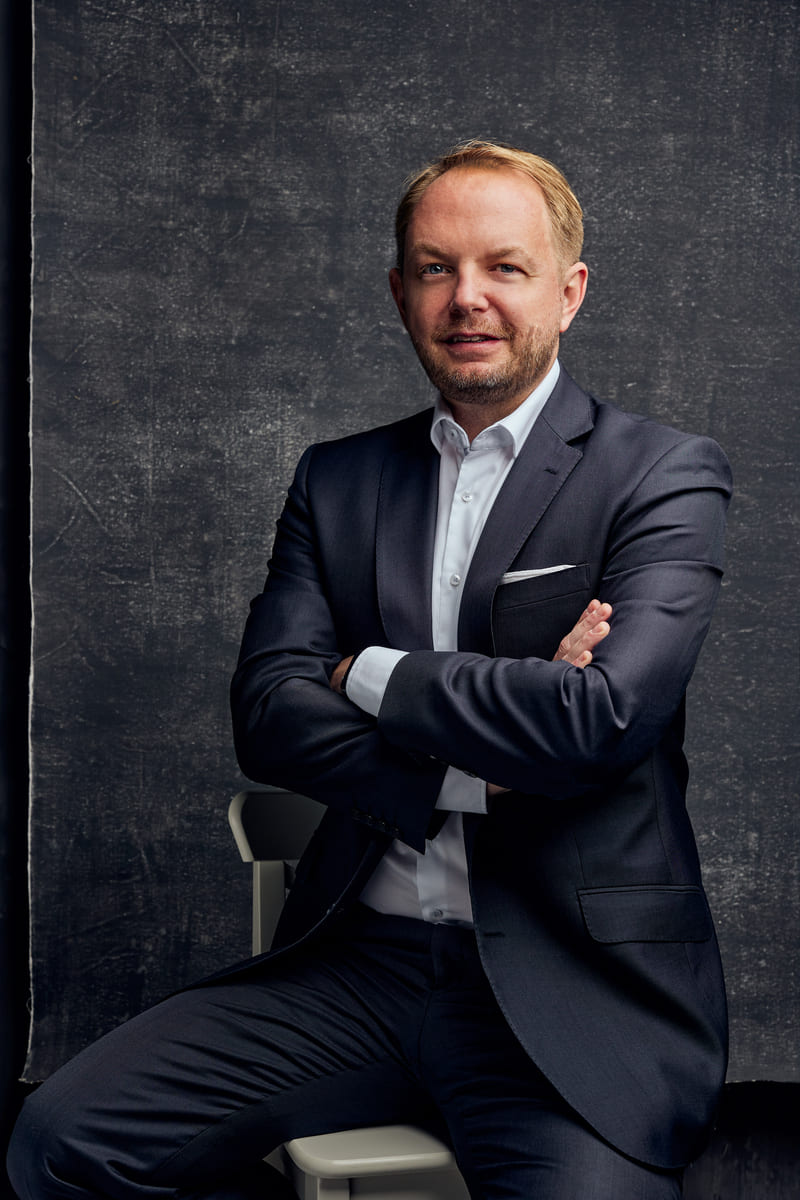
Austrian business magazine trend. has published an in-depth interview with Gregor Bierent, Chief Executive Officer of NF Innova. In it, he explains how traditional banks can match the speed of neobanks and bring their customers into the digital channel.
In the interview, Gregor explains how FINTENSE uses data and artificial intelligence to divide customers into small, dynamic micro-segments. This lets banks adapt both the look and feel of their digital banking and their product offering to each customer’s digital maturity. He describes a fully digital SME loan application, developed with a major Austrian bank, that removes the need to visit a branch up to a defined loan amount.
“Banking services are moving further and further away from pure banking towards an all-round service for entrepreneurs,” says Gregor Bierent. “A business customer should come back to online banking regularly because there is real added value for them there. That is what banks want to achieve, and for this goal FINTENSE offers the ideal digital solution.”
Read the full interview below, translated from German. The original was published in trend. on 20 November 2026: read it on trend.at.
“We bring customers into the digital channel”
Gregor Bierent, CEO of New Frontier Innova, makes it possible for business owners to have a loan in their account within ten minutes, turns online banking into an experience with real added value for users, and helps banks enter the business areas of the future.
Gregor Bierent is Chief Executive Officer of New Frontier Innova (NF Innova), a company specialising in digital banking solutions, headquartered in Vienna with subsidiaries in Southeast Europe.
trend.: More people probably know the New Frontier Innova logo, NF Innova, than the company behind it. What services does New Frontier Innova offer?
Gregor Bierent: We actually see ourselves as something of a hidden champion, or at least a hidden player. New Frontier Innova was founded in 2013 as a start-up from a corporate innovation programme and has since grown as a software production company in digital banking. That means mobile payments, complete account management, trading via smartphone. And today we offer the full range of banking services through digital channels.
trend.: Are you competing with neobanks such as N26 or Revolut?
Gregor Bierent: No. We provide classic, traditional banks with state-of-the-art digital white-label solutions so that they can be just as fast as neobanks, and so that they can win or retain young or tech-savvy audiences, as well as small and medium-sized enterprises, as customers. We are developers, not a neobank.
trend.: What does New Frontier Innova offer traditional banks so that they can operate like neobanks?
Gregor Bierent: Our flagship platform FINTENSE is at the forefront of the global fintech evolution. By using data and artificial intelligence, we can achieve extremely precise personalisation of banking services. Instead of being grouped into broad target groups, users are divided into the smallest dynamic segments. Alongside digital natives, we can identify, for example, hybrid users or digital newcomers.
trend.: How can a bank use this highly targeted customer segmentation?
Gregor Bierent: With FINTENSE, banks can tailor their online banking interfaces individually to their customers, with a look and feel that matches each user’s experience. Depending on how digitally savvy a customer is, the app’s design changes, and so does the product offering.
trend.: So you support the digital transformation of the large traditional banks.
Gregor Bierent: Yes, we are essentially an efficiency driver. With FINTENSE, we help move physical customers to digital channels. And that benefits customers, because we simply offer more functionality online.
trend.: What does this look like in commercial banking?
Gregor Bierent: Here we work with our Business Finance Manager, which is aimed specifically at SME customers. It provides an all-round analysis. Where is money being spent? To what extent are those expenses justified? We also support SMEs with cash flow optimisation and cash flow forecasting. That is a key question, especially for smaller businesses: will my company still have enough cash at the end of the month, or should the bank perhaps help out with an overdraft facility?
trend.: So banks can grow their lending business as a result?
Gregor Bierent: That too, but it is not the main point. Through our platform, we already deliver solutions that companies need for their day-to-day business, such as a higher credit line. This can strengthen trust in the relationship with their main bank. And of course, it also opens up cross-selling and upselling opportunities for the bank.
trend.: Making a pilgrimage to the bank to apply for a loan is hardly a favourite pastime of SME managing directors.
Gregor Bierent: For this, we developed a dedicated solution with a large Austrian bank, for example. The loan application for SMEs is digitalised, so that up to a certain loan amount a branch visit is no longer necessary. Our solution verifies the company’s authorised signatories through the company register, the credit bureau and other sources. In line with the know-your-customer obligations that apply to banks, this is also carried out accordingly for legal entities. This means the application can simply be completed online.
trend.: That sounds almost too easy. What other criteria are assessed when a loan is granted online?
Gregor Bierent: In principle, the review takes place in several steps. First, the company register is used to check whether the applicant is authorised to sign at all. Then the person is precisely identified, with their personal data carefully verified. This is followed by queries to credit reference agencies, in several countries of course. And last but not least, banks also have their own databases for assessing corporate risk. Together, this creates a holistic picture, but thanks to our modern technology, in the shortest possible time.
trend.: And what if a loan application is for more than EUR 50,000?
Gregor Bierent: Then, of course, you ask for a profit and loss statement and the latest annual financial statements. The company provides the documents to the bank via online banking. All the data is then analysed and evaluated with the help of artificial intelligence, much faster than has been usual until now. It is up to the bank whether it wants our system to carry out a more detailed credit check from EUR 50,000 or only at a higher amount. That depends on its risk appetite. But the process remains the same.
trend.: What is the default rate on loans arranged through your platform?
Gregor Bierent: Ultimately, that depends on the bank. We have continuously developed our analysis platform over 15 years. The bank can set the parameters itself. Is its risk appetite high, or is it more risk-averse? How lending is handled is a management decision. We help the bank optimise the process so that an application doesn’t take two or three weeks and require several branch visits. We connect the different systems and then meet the customer in the digital channel.
trend.: What concrete benefits do banks gain from having more customers in online channels?
Gregor Bierent: Banking services are moving further and further away from pure banking towards an all-round service for entrepreneurs. The race for customers is increasingly no longer being run in the classic core business. It is about selling additional services. That is why it is important for banks to find ways to build customer loyalty.
trend.: Is increased digital customer contact measurable?
Gregor Bierent: Statistics show how often customers visit their online channel and how long they stay. The key is to extend that time, because then you can sell additional products, such as insurance. A business customer shouldn’t log in to online banking just once a month to approve salary payments, but should come back regularly because there is real added value for them as an entrepreneur. That is what banks want to achieve. And for this goal, FINTENSE offers the ideal digital solution.
This interview was originally published in German in trend. (trend.at) on 20 November 2026, in cooperation with New Frontier Innova. English translation by NF Innova, republished with the permission of trend.